

Buying a house in Dominican Republic is open to foreigners on exactly the same terms as Dominican citizens. You need a passport, an independent attorney and patience. You do not need residency, a local partner or government approval. The legal sequence runs promise of sale, due diligence, deed of sale, transfer tax, registration, and the whole thing usually takes 30 to 90 days on a clean property.
What goes wrong is almost never the law. It is the paperwork underneath a specific property, and it is the contract the buyer signs before anyone has checked that paperwork. This guide walks the sequence in order, names the checks that catch real problems, and prices the whole thing out.
Quick Facts
Property transactions run under Property Registry Law 108-05, in force since April 2007, and Decree 21-98 removed the old requirement for foreign buyers to obtain presidential approval. The Title Registry simply records foreign purchases for statistical purposes.
Closing costs land near 4.5% of the appraised value: a 3% transfer tax plus legal fees of 1% to 1.5% and minor registry expenses.
The transfer tax is charged on the DGII appraisal rather than the price in your deed, so a contract written low does not reduce it.
Borrowing is expensive. The average Dominican mortgage rate was 11.71% in July 2026, against a weighted bank lending rate of 13.79%, which is why most foreign purchases are cash or developer payment plans.
A property with no approved survey, or deslinde, cannot be recorded at the Registry at all. That single rule explains most of the cheap land listings you will see.
Can Foreigners Buy? The Short Legal Answer
Yes, with no restriction and no residency requirement. Foreign buyers hold title in their own name, with the same rights of ownership, sale and inheritance as a Dominican national. A passport is the only identity document you need to close, and a spouse's signature is required only where the seller is married, not the buyer.
Two practical limits are worth knowing before you fall for a particular plot. Law 305 of 1968 makes the first 60 meters of coastline, measured inland from the high tide mark, public property, and nothing can be built there without a special permit from the Executive Branch. In tourism zones, the Ministry of Tourism also administers building restrictions. Neither stops you buying. Both can stop you building what you had in mind.
Buying a House in Dominican Republic, Step by Step
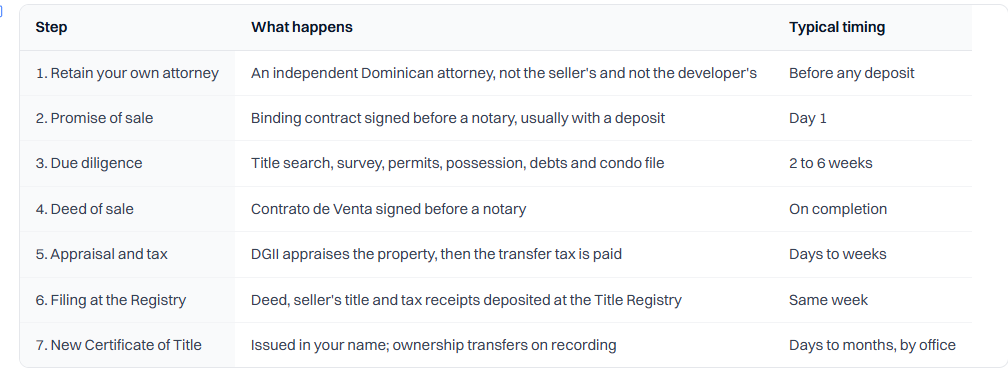
The Dominican sequence does not match the North American one. There is no written offer and written acceptance. After a verbal agreement on price, a binding promise of sale is drafted and signed in front of a notary, and everything else follows from there.
The Promise of Sale Is the Document That Matters
From a practical point of view the promise of sale matters more than the deed of sale, because it describes the entire transaction up to the moment the price is paid in full and the property is ready to be conveyed. A well-drafted one names both parties in full, describes the property legally, sets the price and payment terms, carries a default clause and a delivery date, states what due diligence is required or already done, records the seller's representations and your remedies if they prove false, and obliges the seller to sign the deed on final payment.
Three Ways These Contracts Fail Buyers
Guzman Ariza's guidance, cited above, names the same three defects repeatedly. The buyer pays a large share of the price with no security or direct interest over the property, so if the money is misused the only remedy is suing the seller personally. Payments are not conditioned on clear title or on construction progress, so a seller can demand money or declare you in default without performing. And escrow agents are rarely used, which leaves the seller holding the funds throughout. Condominium buyers in Santo Domingo have lost both deposits and units this way when a developer financed construction with buyer money plus a bank loan secured by a mortgage on the same building, then ran out of road.
The fix for all three is the same and it is cheap: refundable deposit, held in escrow, released against named milestones. If a seller or developer refuses all three, that refusal is the information you came for.
Due Diligence, and the Checks Nobody Mentions
Many attorneys limit due diligence to pulling a status certificate from the Title Registry and calling it done. The full list is longer, and the items at the bottom of it are the ones that generate litigation.
Title search. A certification from the Title Registry naming the owner and any mortgages, liens or encumbrances, confirmed by your attorney reading the underlying file rather than trusting the summary.
Survey and deslinde. An independent surveyor should confirm the property on the ground is the property on the plan. Buyers have taken title to land some distance from the land they thought they were buying.
Permits and use. Whether the property can legally be used for what you intend, including the maritime zone and any tourism-zone building rules.
Possession. That the seller actually holds the property and no squatters' rights exist. Fencing an isolated parcel before closing is standard advice. Where tenants are in place, remember Dominican law protects them and eviction is slow and expensive.
Employees and utilities. Any gardener or caretaker is owed statutory severance by the seller, and if it goes unpaid the buyer can end up liable. Unpaid power, water and cable bills attach to the property the same way.
Condominium file. The declaration, the regulations, approved plans, a certificate that the seller is current on dues, and the minutes of the last three meetings. Those minutes are where a pending special assessment shows up.
What It Costs to Close
Taxes and expenses on a conveyance run to roughly 3.1% of the government-appraised value, almost all of which is the 3% transfer tax, with the rest in certified checks, stamps and registry costs. Legal fees are customarily 1% to 1.5% of the purchase price, with a minimum on properties at or below US$150,000 and a discount above a million. On a US$200,000 purchase, budget around US$9,000 all in at the October 2026 exchange rate.
Then the annual bill begins. IPI is 1% a year on the portion of your combined Dominican property value above RD$10,695,494 for 2026, a little over US$173,000, payable in two installments on 11 March and 11 September. Below that threshold you owe nothing.
A certified tourism project changes both numbers. CONFOTUR benefits waive the transfer tax for the first buyer and exempt the property from IPI for up to 15 years from completion of construction. A pensionado or rentista resident gets a comparable break under Law 171-07, which exempts the transfer tax on a first home and halves the annual property tax.
Financing Options for a Foreign Buyer
Four routes, and most foreign buyers end up on the first or the second.
Cash. The default here, and the reason sellers take cash offers seriously. It also avoids a bank appraisal adding weeks to the timeline.
Developer payment plan. Common on pre-construction, typically a deposit followed by installments through the build. The trade is flexibility for risk, which is exactly why the escrow and milestone points above matter more here than anywhere else.
A Dominican bank mortgage. Available to non-residents at several banks, but on local terms. With the national average mortgage rate sitting near 11.71% and non-residents facing larger down payments and shorter terms than residents, the math rarely beats borrowing at home.
Equity from your home country. A line of credit against a property in the US, Canada or Europe usually carries a lower rate than a Dominican mortgage and makes you a cash buyer here. This is the quiet favorite among repeat buyers.
Whichever route you take, agree the currency in writing. A peso-denominated loan against a dollar-priced property introduces a currency mismatch that nobody notices until the rate moves.
Starting as an Investor Rather Than a Resident
If the purchase is an investment rather than a home, three figures shape it. The national median apartment asking price is about US$210,000, or US$2,000 per square meter, so that is the size of a typical entry ticket. Rental income earned here is taxable here, and payments of Dominican-source income abroad to non-residents are generally subject to a 27% withholding. And at sale, an individual now pays 10% on the capital gain, while a company pays 27%.
That last line is the reason the ownership structure deserves a conversation before you sign rather than after. In our own market, asking prices published by Diario Libre in September 2026 from Ubikala data put the Las Terrenas median near US$2,225 per square meter, so a small rentable unit here starts around US$150,000. You can see the current range in our Las Terrenas listings.
Inheritance, and the Clause Most Buyers Skip
Dominican inheritance law normally provides for forced heirship, meaning a fixed share of an estate must pass to certain heirs regardless of what a will says. Inheritance tax is 3% of the appraised value of the estate, and there are no restrictions on foreigners inheriting Dominican property.
A conflict of law statute enacted in December 2014 allows foreigners to have their own national law govern the inheritance of their Dominican real estate. That is a meaningful option and it is not automatic. Raise it with your attorney at purchase, when it costs almost nothing, rather than leaving your family to discover forced heirship later.
When to Walk Away
Here is the part that works against our own interest to say. Some deals should not be rescued, and a broker who pushes through the following is costing you more than the commission is worth.
Walk away from a property with no approved deslinde unless you are prepared to fund and wait out the survey process with the price adjusted accordingly, because the sale cannot be recorded without one. Walk away from a seller who will not use escrow and will not condition payments on clear title. Walk away from anything inside the 60-meter maritime zone that someone assures you is fine. And walk away from a hurried closing, because the pressure to sign before due diligence finishes is itself the warning.
None of those is common on a well-prepared listing. All of them are common enough on a bargain, and the pattern is consistent: the problems cluster on properties that have never been through a careful sale before. A unit in a building that has already transacted cleanly half a dozen times carries a fraction of the risk of an untitled parcel changing hands within a family for thirty years.
Frequently Asked Questions
What is the process for purchasing land or a home in the Dominican Republic?
Retain an independent attorney, sign a promise of sale before a notary, complete due diligence on the title, sign the deed of sale, pay the 3% transfer tax on the DGII appraisal, and file at the Title Registry, which issues a new Certificate of Title in your name. Ownership transfers when the sale is recorded, not when you pay. Expect 30 to 90 days on a clean property.
Can foreigners buy property in the Dominican Republic?
Yes, with the same rights as Dominican citizens and no residency requirement. Decree 21-98 abolished the old presidential approval rule, leaving only a requirement that the Title Registry record foreign purchases for statistical purposes. A passport is the only identity document needed to close.
What are the financing options for a real estate purchase in the Dominican Republic?
Cash, a developer payment plan, a Dominican bank mortgage, or borrowing against equity at home. The average Dominican mortgage rate was 11.71% in July 2026, and non-residents face larger down payments and shorter terms than residents, so most foreign buyers either pay cash or use a developer plan during construction.
How much does it cost to close on a property in the Dominican Republic?
Around 4.5% of the appraised value in total. That comprises roughly 3.1% in transfer taxes and minor registry expenses combined, of which 3% is the transfer tax itself, plus legal fees customarily 1% to 1.5% of the purchase price. A CONFOTUR-certified unit removes the transfer tax for the first buyer.
How can I start investing in the Dominican Republic as a foreigner?
Buy in your own name, with an independent attorney, in a market you have actually visited. The national median apartment asks about US$210,000, rental income earned here is taxable here, and an individual selling pays 10% on the gain against 27% for a company. Decide the ownership structure before you sign the promise of sale, not after.
Do I need residency to buy a house in the Dominican Republic?
No. Residency is unrelated to the right to own property, and plenty of owners hold Dominican homes on tourist entries for years. Residency under Law 171-07 does carry property tax benefits, including an exemption from the transfer tax on a first home and a 50% reduction in the annual property tax, so it is worth sequencing if you plan to apply anyway.
The Order That Protects You
Buying a house in Dominican Republic is straightforward when the sequence runs attorney, contract, checks, money, in that order. Almost every bad outcome we see started with money moving before the checks were finished. Get the order right and the law here works perfectly well for a foreign buyer.
Considering a Conversation
To reach Leo and the Leo Estate Group team: contact page. We can tell you what a specific property's title file looks like before you commit to a promise of sale, and recommend independent attorneys who will not simply pull a certificate and call it due diligence.
Phone
+1 829 707 0999
Office
Sector La Bonita, Calle Jose Antonio Martinez, beside Mosquito Boutique Hotel, Las Terrenas 32000, Samana
Hours
Monday to Sunday, 9am to 5pm
Sources
Guzman Ariza, Buying Real Estate in the Dominican Republic: Property Registry Law 108-05 in force since April 2007, the promise of sale provisions and their three common defects, the due diligence checklist, the deslinde rule, the 60-meter maritime zone under Law 305 of 1968, closing costs of about 3.1% plus legal fees of 1% to 1.5%, Decree 21-98 on foreign buyers, and inheritance at 3% with forced heirship.
PwC Worldwide Tax Summaries, Dominican Republic, Other taxes: Real Property Transfer Tax at a basic rate of 3% on any transfer of real estate ownership.
Revista Mercado, Dominican lending rates through July 2026: average mortgage rate of 11.71% in July 2026 and a weighted multiple-bank lending rate of 13.79%.
DGII Help Centre, exempt amount for the Real Estate Property Tax: 2026 IPI exempt amount of RD$10,695,494, below which no annual property tax is due.
CONFOTUR, Ministry of Tourism, Benefits: exemption from the transfer tax and from the annual property tax for up to 15 years from completion of construction.
Pellerano and Herrera, tax exemptions under Law 171-07: exemption from the 3% transfer tax on a first home and a 50% reduction in the annual property tax for pensionado and rentista residents.
Alburquerque, Legal Guide to the Dominican Republic, Tax Law: flat 10% capital gains rate for individuals selling real property, 27% for legal entities, and the 27% withholding on Dominican-source income paid abroad.
Dominican Scope, Dominican apartment prices hit US$2,000 per square meter: national median apartment asking price of about US$210,000, or US$2,000 per square meter.
Diario Libre, Las Terrenas and the new generation of luxury property tourism: August 2026 median asking price of about US$2,225 per square meter in Las Terrenas, from Ubikala data.
Acento, Banco Central reference exchange rate, October 2026: peso to dollar reference rate used for every conversion on this page.